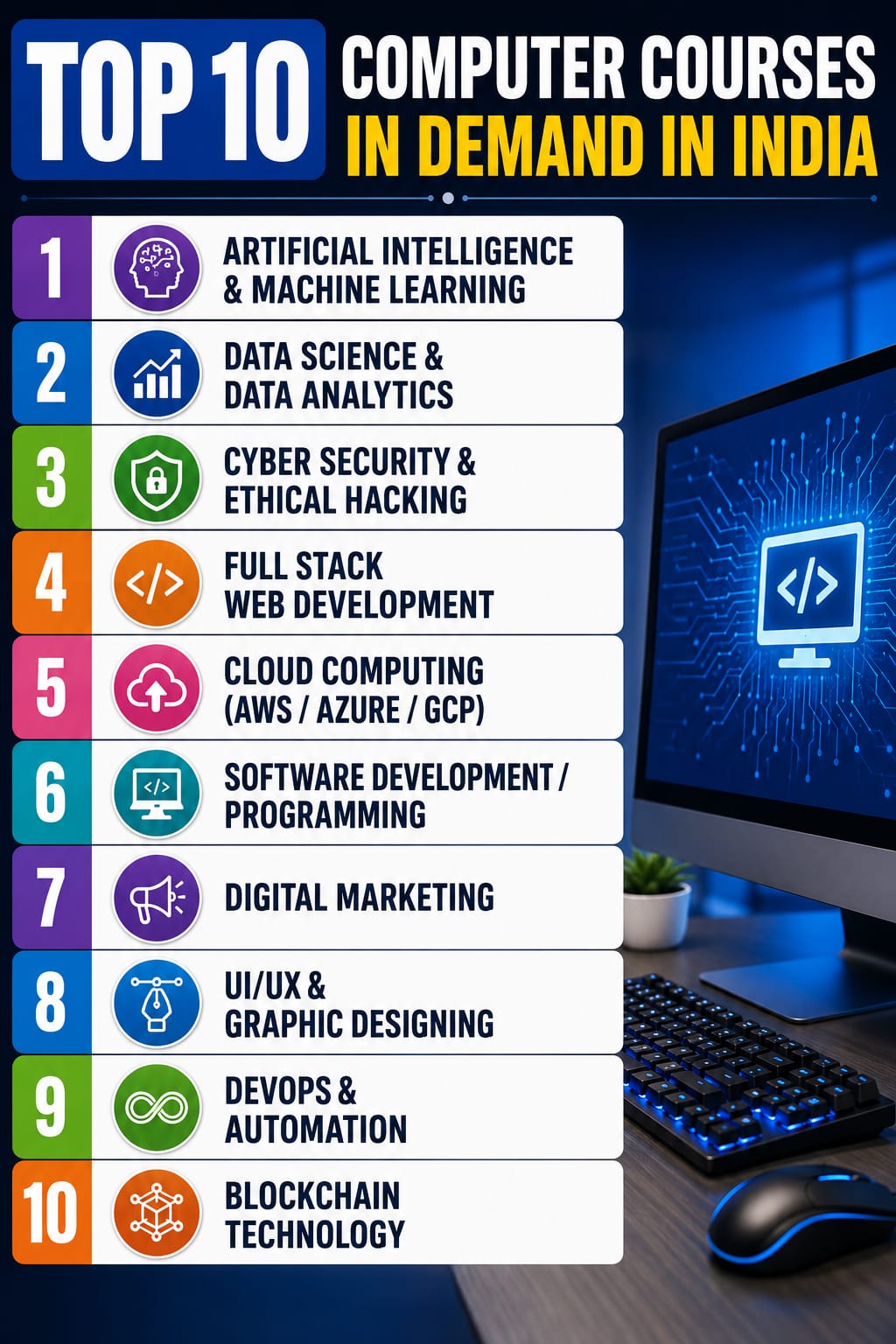
Top 10 Computer Courses In Demand In India 2026 Why Computer Courses Are in High Demand;- Offices, startups, schools, and multinational companies now harness the power of computer technology. As a result, the most demanding computer courses open doors to high-paying jobs and exciting opportunities for career growth.
Choosing the best computer institute franchise in India gives you an edge over others. It builds trust with students and helps you grow faster because of the brand’s reputation.
In short, learning or teaching computer skills is a great step towards a better future. Whether you’re learning or starting your own institute, now is the perfect time to be part of India’s digital growth story.
What Makes a Course “High Demand” in 2026?
Before selecting, understand the criteria:
-
Job availability in India
-
Industry demand (not hype)
-
Salary potential
-
Short learning duration
-
Practical skill-based
1.MS Office (Microsoft Office)
Microsoft Office is one of the most essential computer courses for beginners and professionals alike.
-
Course Overview: Includes training in Word, Excel, PowerPoint, and Outlook.
- Duration: 1 to 3 months
- Skills Acquired: Document creation, spreadsheets, presentations, and email management.
- Career Scope: Administrative jobs, data entry, office assistant, receptionist.
- Best For: Beginners, school/college students, office staff.
2. DCA (Diploma in Computer Applications
DCA is a foundation-level course offering knowledge of basic computer applications.
- Course Overview: Covers MS Office, internet usage, basic programming, and data handling.
- Duration: 6 to 12 months
- Skills Acquired: Basic computing, document editing, spreadsheets, and database handling.
- Career Scope: Computer operator, data entry, receptionist, admin executive.
- Best For: Freshers, job seekers, and those new to IT.
3. ADCA (Advanced Diploma in Computer Applications)
This course is an upgraded version of DCA, providing more advanced knowledge and skills.
- Course Overview: Includes advanced MS Office, Tally, C/C++ programming, and basic web design.
- Duration: 12 to 18 months
- Skills Acquired: Programming, office tools, accounting software.
- Career Scope: Computer trainer, junior programmer, back-office executive.
- Best For: DCA holders and students aiming for a deeper skill set.
4. CCC+ (Course on Computer Concepts Plus)
A government-recognized course focusing on basic computer literacy.
- Course Overview: Fundamentals of computers, MS Office, internet browsing, and cyber security basics.
- Duration: 3 months
- Skills Acquired: Basic computing, email, presentations, online communication.
- Career Scope: Entry-level computer jobs, clerical positions, and government jobs.
- Best For: Government exam aspirants and computer beginners.
5. Advanced Excel
Excel is a critical tool for business analysis and data handling.
- Course Overview: Includes pivot tables, VLOOKUP, macros, dashboards, and data visualization.
- Duration: 1 to 2 months
- Skills Acquired: Data analysis, reporting, spreadsheet automation.
- Career Scope: MIS executive, data analyst, accountant, HR analyst.
- Best For: Finance professionals, analysts, HR, and admin staff.
6. DFA (Diploma in Financial Accountin
DFA is focused on accounting principles and software used in financial sectors.
- Course Overview: Includes Tally, GST, income tax, payroll, and Excel.
- Duration: 6 to 12 months
- Skills Acquired: Bookkeeping, tax filing, computerized accounting.
- Career Scope: Accountant, accounts assistant, tax consultant.
- Best For: Commerce students and aspiring accountants.
7. Tally (With GST)
Tally is one of the most widely used accounting software in India.
- Course Overview: Basic to advanced Tally ERP9/Prime, GST, TDS, inventory management.
- Duration: 1 to 3 months
- Skills Acquired: Business accounting, tax handling, invoicing.
- Career Scope: Tally operator, accountant, GST consultant.
- Best For: Commerce background students and small business owners.
8. Diploma in Web Development and Programming
This course prepares students for careers in website development and coding.
- Course Overview: HTML, CSS, JavaScript, PHP, MySQL, Bootstrap, and frameworks.
- Duration: 6 to 12 months
- Skills Acquired: Frontend and backend web development.
- Career Scope: Web developer, UI/UX designer, freelance developer.
- Best For: Creative individuals, aspiring coders, freelancers.
9. Diploma in Digital Marketing
Digital marketing is one of the fastest-growing career paths in India.
- Course Overview: SEO, SEM, social media marketing, content marketing, email marketing, analytics.
- Duration: 3 to 6 months
- Skills Acquired: Online marketing, branding, lead generation.
- Career Scope: Digital marketer, SEO executive, social media manager.
- Best For: Entrepreneurs, marketing professionals, content creators.
10. Stenographer (with Computer Typing)
This course trains candidates in shorthand, typing, and computer operations.
- Course Overview: English/Hindi shorthand, MS Office, typing practice, data formatting.
- Duration: 6 to 12 months
- Skills Acquired: Fast typing, transcription, office management.
- Career Scope: Stenographer in courts, government offices, and corporates.
- Best For: Government job aspirants and clerical role seekers.
1. Strong Industry Hiring Demand
The clearest sign is whether companies are actively hiring for those skills.
Courses connected to sectors with rapid growth are dominating demand, especially:
- AI & Machine Learning
- Data Science
- Cybersecurity
- Cloud Computing
- DevOps
- Renewable Energy
- Digital Marketing with AI
- Business Analytics
AI and cybersecurity alone are powering a major share of campus hiring in Indian tech hubs.
Examples of high-demand courses:
- B.Tech / M.Tech in AI & Data Science
- Cybersecurity certifications
- Cloud Architecture programs
- Data Engineering bootcamps
- Business Analytics MBAs
2. Courses That Work With AI, Not Against It
2026 employers prefer people who can:
- use AI tools,
- automate workflows,
- interpret data,
- manage systems,
- make strategic decisions.
Purely repetitive skills are losing value.
That’s why courses combining human judgment + technology are rising fastest.
For example:
- AI + Healthcare
- AI + Finance
- Cybersecurity + AI
- Marketing + Analytics
- Product Management + AI tools
Industry reports show AI-related skills now command large salary premiums because businesses are integrating AI into almost every function.
3. Skill-Based Learning Beats Theory-Only Degrees
A major 2026 shift:
Employers increasingly prefer job-ready portfolios over memorized theory.
High-demand courses now include:
- live projects,
- internships,
- labs,
- certifications,
- real-world tools,
- industry partnerships.
Courses focused only on textbook learning are struggling unless paired with practical exposure.
Reddit discussions from working professionals repeatedly emphasize:
projects and practical application matter more than collecting certificates.
4. Courses Linked to Long-Term Global Problems
The best courses solve problems that will still exist 10 years from now.
That’s why these areas remain strong:
- Cybersecurity → rising digital threats
- Renewable energy → climate transition
- Data science → explosion of business data
- AI infrastructure → huge compute growth
- Healthcare technology → aging populations
- Sustainability → government and corporate mandates
For example, rising AI infrastructure demand is increasing need for cloud, data center, energy, and cybersecurity specialists.
5. Courses That Create Multiple Career Paths
High-demand courses in 2026 are flexible.
A good course should allow movement into multiple industries.
For example:
| Course Area | Possible Careers |
|---|---|
| AI & ML | AI Engineer, NLP Engineer, Automation Specialist |
| Data Science | Analyst, BI Specialist, Data Engineer |
| Cybersecurity | SOC Analyst, Ethical Hacker, Cloud Security |
| Cloud Computing | DevOps, SRE, Cloud Architect |
| Digital Marketing | SEO, Growth, Performance Marketing |
| Business Analytics | Product, Operations, Consulting |
The broader the applicability, the safer the course.
6. Employer Skill Gaps Matter More Than Student Interest
A course becomes “high demand” when:
companies need talent faster than universities can produce it.
That’s why cybersecurity is especially strong:
there’s still a global shortage of skilled professionals.
Meanwhile, some highly popular fields become overcrowded at entry level.
Example:
- Basic “Data Science” without strong fundamentals is becoming saturated.
- Practical AI engineering and cloud-native AI systems remain in shortage.
7. Courses With Continuous Upskilling Potential
In 2026, careers evolve rapidly.
The best courses are not “one-time learning.”
They create a foundation for lifelong adaptation.
Strong examples:
- AI/ML
- Cloud + DevOps
- Cybersecurity
- Full-stack engineering
- Product management
- Data engineering
These fields keep expanding instead of becoming obsolete quickly.
The Biggest High-Demand Course Categories in 2026
Technology & AI
- Artificial Intelligence
- Machine Learning
- Data Science
- Data Engineering
- Cloud Computing
- Cybersecurity
- DevOps
- Full-Stack Development
Business & Management
- Business Analytics
- Product Management
- Digital Marketing
- FinTech
- AI for Business
Sustainability & Future Industries
- Renewable Energy
- Environmental Science
- EV Technology
- Smart Manufacturing
Healthcare & Bio-Tech
- Health Informatics
- Biotechnology
- AI in Healthcare
- Public Health Analytics
The Real Formula
In 2026, a course is “high demand” if it has:
High Demand=Industry Need+ Skill Shortage+ Practical Skills+ AI Compatibility +Long-Term Relevance\text{High Demand} = \text{Industry Need} + \text{Skill Shortage} + \text{Practical Skills} + \text{AI Compatibility} + \text{Long-Term Relevance}
FAQs on Computer Courses After 12th
Q1. Which computer course is best after 12th?
Answer- The best depends on your stream. Science students often pursue B.Tech in Computer Science, AI, or Data Science, while Arts and Commerce students may choose BCA, Digital Marketing, or Web Design.
Q2. Can I do computer courses after 12th without maths?
Answer- While advanced programs like B.Tech CSE require Mathematics, courses like Digital Marketing, Graphic Design, and Web Development do not.
Q3. Which short-term computer course is best for jobs?
Answer-Cybersecurity, Data Analytics, and Digital Marketing are the most job-oriented in 3–6 months.
Q4. Can Arts and Commerce students pursue high-paying computer jobs?
Answer- Yes. With courses like BCA, Animation, E-Commerce, or Digital Marketing, students from any stream can earn competitive salaries.
Q5. What is the average salary after completing computer courses after 12th?
Answer- Starting salaries range from ₹3–6 LPA for entry-level roles to ₹10–20 LPA for specialized areas like AI, ML, and Cloud.
|
Mp Board Paper – शिक्षा का समर्पित मंच प्रस्तावना आज की तेजी से बदलती डिजिटल दुनिया में, शिक्षा का महत्व किसी भी प्रतियोगी परीक्षा में सफल होने के लिए अनिवार्य हो गया है। छात्रों के लिए एक विश्वसनीय और समर्पित प्लेटफ़ॉर्म की आवश्यकता होती है, जो उन्हें सही दिशा में मार्गदर्शन कर सके। इसी बात को ध्यान में रखते हुए, Mpboardpaper.com एक ऐसा अनूठा मंच है, जो मध्य प्रदेश के बोर्ड परीक्षाओं में आपके हर सवाल का समाधान पेश करता है। चाहे आपके बच्चे की परीक्षा समीप हो या आप खुद बोर्ड परीक्षा की तैयारी कर रहे हों, Mpboardpaper.com आपकी सभी अध्ययन संबंधी आवश्यकताओं को पूरा करने में मदद करता है। Mpboardpaper.com का परिचय Mpboardpaper.com एक ऐसा अत्याधुनिक मंच है, जो छात्रों के लिए मध्यम और उच्च विद्यालय स्तर पर पाठ्यक्रम संबंधी सभी सामग्री, पुरालेख, और अध्ययन के लिए उपयोगी संसाधनों को एकत्र करता है। हमारा मुख्य उद्देश्य छात्रों की सहायता करना और उन्हें परीक्षा के दौरान सही जानकारी, सामग्री और मार्गदर्शन प्रदान करना है। हमारी वेबसाइट पर आपको निम्नलिखित सेवाएँ मिलेंगी:
शिक्षा की हर सीढ़ी पर सहारा Mpboardpaper.com न केवल एक शिक्षा प्लेटफार्म है, बल्कि यह छात्रों की शिक्षा की हर सीढ़ी पर काम करने का संकल्प लिए हुए है। हम मानते हैं कि सभी छा त्रों में अद्वितीय क्षमताएँ होती हैं, और हमें उनकी पहचान करने और उन्हें विकसित करने में सहायता करनी चाहिए।
निष्कर्ष Mpboardpaper.com एक ऐसी वेबसाइट नहीं है जो बस एक परीक्षा की तैयारी करने में मदद करती है, बल्कि यह एक समर्पित शैक्षणिक सहारा है जो छात्रों को उनके शिक्षा के सफर में हर कदम पर मार्गदर्शन करता है। हमारे साथ, छात्र अपनी पूर्ण क्षमता की पहचान कर सकते हैं और उन्हें अपनी शैक्षणिक यात्रा में सकारात्मक परिणाम पाने का अवसर मिलता है। यदि आप मध्य प्रदेश बोर्ड की परीक्षाओं में उत्कृष्टता हासिल करना चाहते हैं, तो Mpboardpaper.com आपकी सबसे अच्छा साथी बन सकता है। आज ही हमारी वेबसाइट पर जाएँ और अपने अध्ययन को उस स्तर तक बढ़ाएँ जो आपको सफलता की ओर अग्रसर करे। शिक्षा के प्रति समर्पित रहें और अपनी मेहनत के बल पर सफलता की सीढ़ियाँ चढ़ते रहें! |